

Introduction: Understanding the Hypnotherapy Session Process
If you've ever wondered what actually happens during a hypnotherapy session, you're not alone. Many people approach hypnotherapy with a mixture of curiosity and uncertainty, often influenced by dramatic portrayals in movies or stage shows that bear little resemblance to the genuine therapeutic process.
A hypnotherapy session process is a structured, collaborative experience designed to help you access your natural ability to create positive change in your life. Unlike the theatrical hypnosis you might have seen, therapeutic hypnosis is a gentle, guided process where you remain fully aware and in control throughout the entire experience.
Understanding what to expect during your therapy experience can significantly impact its effectiveness. When you know what's coming, you can relax more fully, participate more actively, and gain greater benefit from each session. This knowledge also helps dispel common fears and misconceptions that might otherwise create resistance to the process.
During a typical session, you'll work with a qualified practitioner through several distinct phases. These treatment steps begin with a conversation about your goals and concerns, progress through a relaxation process, include the therapeutic work itself, and conclude with a gentle return to your normal state of awareness. Each phase serves a specific purpose in creating the conditions for positive change.
The entire process is designed around your comfort, safety, and specific objectives. Whether you're seeking support for stress management, habit change, personal development, or overcoming specific challenges, the session structure remains consistent while the content is tailored to your unique needs.
Professional hypnotherapy sessions typically last between 60 to 90 minutes, allowing sufficient time for each phase of the process. This comprehensive approach ensures you receive maximum benefit from your investment in personal growth and positive change.
Before Your First Session: Preparation and Expectations
The journey toward positive change through hypnotherapy begins well before you settle into the comfortable chair in your practitioner's office. The initial consultation and intake process serves as the foundation for your entire therapy experience, setting the stage for successful outcomes.
During your initial consultation, whether conducted by phone or in person, your practitioner will gather essential information about your background, current challenges, and desired outcomes. This isn't merely paperwork – it's an opportunity to begin building the trust and understanding that makes hypnotherapy most effective. You'll discuss your specific goals, any previous experiences with hypnotherapy or similar approaches, and address any questions or concerns you might have.
Setting realistic expectations proves crucial for success. Many people arrive expecting dramatic, overnight transformations, while others worry they won't be "hypnotizable" at all. The reality lies somewhere between these extremes. Most people begin noticing positive shifts after their first session, with more substantial changes developing over multiple sessions. Some experience profound insights immediately, while others find the changes emerging gradually in their daily lives.
Preparing mentally for your first session involves releasing the need to "perform" or achieve any particular state. Hypnosis is a natural process – you've likely experienced similar states while absorbed in a good book, driving a familiar route, or drifting off to sleep. The key is approaching the session with openness and curiosity rather than expectation or effort.
What should you bring? Simply yourself and an open mind. Wear comfortable clothing that doesn't restrict your breathing or circulation. Avoid caffeine several hours before your session if possible, as it can interfere with relaxation. Consider arriving a few minutes early to settle in and transition from the outside world.
Common myths about hypnotherapy sessions persist despite decades of research and clinical practice. You won't lose control, reveal secrets, or get "stuck" in hypnosis. You can't be made to do anything against your values or beliefs. You'll remain aware of your surroundings and can speak, move, or emerge from the state at any time. Most people are pleasantly surprised by how normal and comfortable the experience feels.
The hypnotherapy session process works best when you understand it as a collaborative partnership. Your practitioner guides the process, but you remain an active participant. This understanding helps create the optimal mindset for therapeutic success.
Professional practitioners will always discuss confidentiality, answer your questions thoroughly, and ensure you feel completely comfortable before beginning any therapeutic work. This preparation phase is just as important as the session itself.

The Pre-Session Consultation: Building Trust and Understanding
The moments before the hypnotic work begins are crucial for creating the foundation of your successful therapy experience. This pre-session consultation represents far more than simple preparation – it's where the therapeutic relationship solidifies and your path to positive change becomes clearly defined.
During this phase, your practitioner will invite you to share your goals and concerns in detail. This isn't about judging or analyzing your challenges, but rather understanding exactly what you hope to achieve. Whether you're seeking support for managing stress, changing unwanted habits, building confidence, or addressing specific fears, this conversation helps tailor the entire session to your unique needs and circumstances.
A thorough review of relevant medical history and any contraindications ensures your safety and comfort throughout the process. While hypnotherapy is generally safe for most people, certain conditions or medications might influence the approach or techniques used. This review isn't meant to exclude anyone from receiving support, but rather to customize the experience appropriately.
Your practitioner will explain exactly what will happen during the hypnotherapy session process, demystifying each phase and addressing any remaining questions or concerns. This explanation helps you understand your role as an active participant rather than a passive recipient of the process. You'll learn about the different phases, what you might experience, and how to get the most from each part of the session.
Creating a comfortable environment extends beyond the physical space, though attention to lighting, temperature, and seating certainly matters. The emotional environment proves equally important – you should feel completely safe, accepted, and free from judgment. Professional practitioners work carefully to establish this sense of security and trust.
This consultation phase also involves setting clear boundaries and expectations for the therapeutic work. You might discuss what topics feel comfortable to explore, any concerns about the process, and how you prefer to receive suggestions and guidance. This collaborative approach ensures the session unfolds in a way that feels right for you.
Many practitioners use this time to demonstrate simple relaxation techniques or answer questions about what hypnosis actually feels like. This preview can help reduce any remaining anxiety and allow you to begin experiencing the calm, focused state that facilitates positive change.
The consultation concludes when both you and your practitioner feel confident about moving forward with the therapeutic work. This might take five minutes or twenty – the timing matters less than ensuring you feel completely prepared and comfortable with the process ahead.

Want to know what to expect before you book?
Reserve a free 30-minute phone consultation with Vittoria Fazio and get your questions answered.
Step-by-Step Breakdown of Treatment Steps
Phase 1: Relaxation and Induction
The transition into the therapeutic state begins with the relaxation and induction phase, where your practitioner guides you into a comfortable, focused state of awareness. This process typically starts with progressive relaxation techniques designed to help your body and mind naturally settle into a more receptive state for positive change.
You'll likely be invited to find a comfortable position, usually seated in a reclining chair or lying down, with your arms and legs uncrossed and your clothing loose enough to allow easy breathing. The goal is finding a position you can maintain comfortably for the duration of the session without needing to adjust or move.
Progressive relaxation often begins with focused breathing exercises. Your practitioner might guide you to notice your natural breathing rhythm, then gradually slow and deepen each breath. This isn't forced or uncomfortable – simply a gentle invitation to breathe more fully and calmly than you might during your busy day.
The relaxation typically progresses systematically through different parts of your body. You might be guided to notice and release tension in your shoulders, arms, face, or legs. Some practitioners use counting techniques, others employ imagery of peaceful places, and many combine several approaches based on what seems most effective for you.
During this phase, you'll notice your awareness beginning to shift. External sounds might seem more distant, your body may feel heavier or lighter, and your thoughts often slow down naturally. This is completely normal and indicates that the process is working effectively. You remain fully aware and in control – you're simply entering a more relaxed, focused state.
The induction process is completely collaborative. Your practitioner pays close attention to your responses and adjusts the approach accordingly. If something doesn't feel right or comfortable, you can always speak up or make adjustments. The goal is creating a state that feels pleasant and peaceful for you.
Most people are surprised by how natural and comfortable this phase feels. Rather than something mysterious or dramatic, it typically feels like the relaxed state you might experience while daydreaming, absorbed in meditation, or drifting peacefully before sleep.

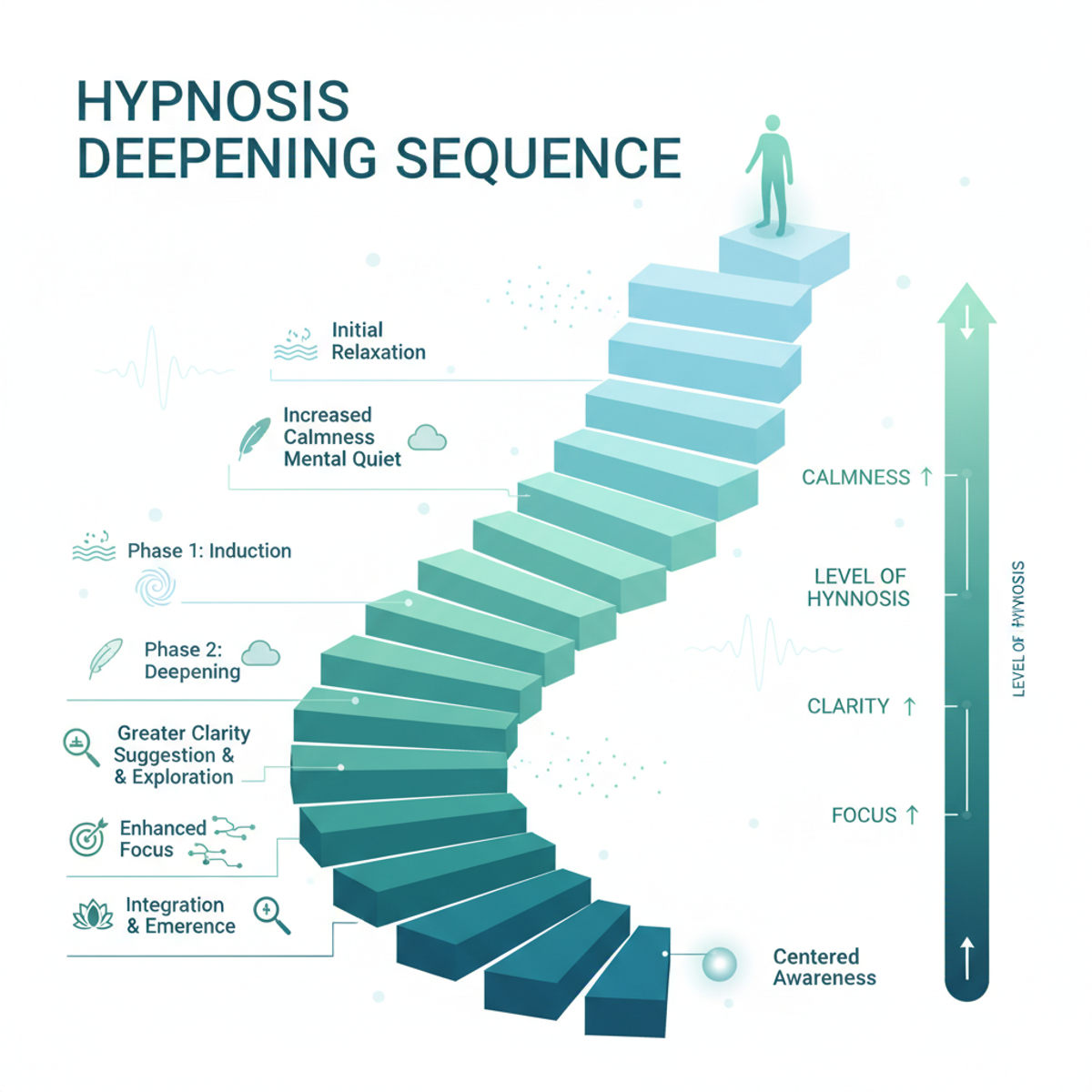
Phase 2: Deepening the Hypnotic State
Once you've achieved a comfortable state of relaxation, your practitioner will guide you into a deeper level of focused awareness. This deepening phase enhances your ability to access your inner resources for positive change while maintaining the safety and control that characterize professional hypnotherapy.
Several techniques might be employed to enhance your relaxation and focus. Some practitioners use progressive counting methods, perhaps counting down from ten to one while suggesting that each number brings deeper relaxation and greater receptivity to positive suggestions. Others might guide you through imagery of descending stairs, riding an elevator, or walking down a peaceful path.
What you'll experience during this phase varies from person to person, but most people report a pleasant sense of floating, sinking, or settling deeper into comfort. Your body typically feels quite relaxed, almost as if you're melting into the chair or surface supporting you. Meanwhile, your mind often becomes quieter, with fewer distracting thoughts competing for attention.
It's important to understand that "deeper" doesn't mean less aware or less in control. Instead, it refers to a more focused state where you can concentrate fully on the therapeutic work without the usual mental chatter and external distractions. Many people describe it as similar to being completely absorbed in a fascinating book or movie.
Your practitioner will continue monitoring your comfort and responsiveness throughout this phase. They might suggest that you signal with a finger movement if you need anything adjusted, or simply observe your natural responses to ensure you're progressing comfortably through the treatment steps.
During deepening, you maintain complete control over your experience. You can speak if needed, adjust your position for comfort, or emerge from the state entirely if you choose. This control actually enhances the effectiveness of the process because you can relax completely knowing you remain safe and autonomous.
Some practitioners incorporate multiple deepening techniques within a single session, while others prefer to use one method consistently. The choice depends partly on your individual responses and partly on the therapeutic goals for your particular session. The key is achieving a state where positive change work can be most effective.
Phase 3: Therapeutic Work and Suggestions
The heart of your hypnotherapy session process occurs during the therapeutic work phase, where your practitioner delivers carefully crafted suggestions and interventions designed to support your specific goals. This is where the real work of positive change takes place, building on the relaxed, focused state you've achieved in the previous phases.
The therapeutic interventions will be specifically tailored to address your individual needs and objectives. If you're working on stress management, the suggestions might focus on developing greater calm and resilience in challenging situations. For habit change, the work might involve strengthening your motivation and ability to make healthier choices. Each session is uniquely designed around your particular circumstances and desired outcomes.
Suggestions are typically delivered in positive, present-tense language that speaks directly to your subconscious mind's natural ability to create positive change. Rather than focusing on what you want to stop or avoid, the emphasis is placed on what you want to achieve and experience. For example, suggestions for someone addressing anxiety might focus on feeling calm, confident, and capable rather than on not feeling anxious.
Your active participation during this phase is crucial for maximum effectiveness. While you're in a relaxed state, your mind remains engaged and responsive. You might be asked to imagine yourself successfully handling challenging situations, to visualize achieving your goals, or to connect with feelings of confidence and capability.
Some practitioners incorporate metaphorical stories or imagery that speaks to your particular situation. These metaphors can be powerfully effective because they communicate with the creative, intuitive parts of your mind that often hold the keys to lasting positive change. You might hear stories about trees growing strong despite storms, or butterflies emerging from cocoons – imagery that resonates with your own transformation process.
The therapeutic work often includes post-hypnotic suggestions designed to extend the benefits of your session into your daily life. These suggestions help reinforce positive changes and provide you with tools and resources you can access whenever needed. You might be given a phrase to repeat, a breathing technique to use, or an image to visualize when you need support.
Throughout this phase, your practitioner pays careful attention to your responses, adjusting the approach as needed to ensure maximum effectiveness. The goal is creating positive changes that feel natural, sustainable, and aligned with your values and objectives.
What You'll Actually Experience During Your Session
Understanding what you'll actually feel and experience during your therapy experience helps demystify the process and allows you to fully benefit from each session. Most people are pleasantly surprised to discover that hypnotherapy feels quite different from their expectations, typically more natural and comfortable than anticipated.
Physically, you'll likely notice a profound sense of relaxation throughout your body. Many people describe feeling as though they're sinking into the chair or surface supporting them, while others feel a pleasant lightness or floating sensation. Your breathing naturally slows and deepens, and any tension you arrived with typically melts away during the early phases of the session.
Your awareness during hypnotherapy operates on multiple levels simultaneously. While you remain conscious and alert to what's happening in the session, you also access deeper levels of consciousness where positive change can occur more easily. This is similar to the state you experience while absorbed in a captivating book – you're aware of reading, but also deeply engaged with the story unfolding in your imagination.
Mental awareness during the hypnotherapy session process often feels like a pleasant daydream or meditation. Your thoughts typically slow down significantly, and the mental chatter that usually occupies your attention fades into the background. This quieter mental state allows you to focus completely on the therapeutic work without the usual distractions and analytical thinking.
Maintaining control throughout the treatment steps is a fundamental aspect of professional hypnotherapy. You can speak at any time if you need something adjusted, you can move to maintain comfort, and you can emerge from the relaxed state whenever you choose. This control actually enhances the effectiveness of the process because you can relax completely knowing you remain safe and autonomous.
Common reactions during sessions include a sense of time distortion – sessions often feel much shorter or occasionally longer than they actually are. You might experience vivid mental imagery, particularly if your practitioner uses visualization techniques. Some people notice heightened awareness of sounds, while others find external noises fading into the distance.
Emotional responses during sessions are typically positive, with many people experiencing feelings of calm, peace, and optimism. You might feel more connected to your inner wisdom and strengths, or experience insights about your situation that weren't apparent before. Occasionally, people process emotions related to their challenges, which is completely normal and often therapeutic.
It's important to remember that there's no "right" way to experience hypnotherapy. Some people go very deep into relaxation, while others maintain a lighter state throughout. Some experience vivid imagery, while others focus more on feelings or internal dialogue. All of these experiences are perfectly normal and effective.
Most people leave their sessions feeling refreshed, calm, and optimistic about their ability to create positive changes. The combination of deep relaxation and therapeutic work typically produces a pleasant sense of well-being that extends well beyond the session itself.

The Emergence Process: Returning to Full Awareness
The conclusion of your therapeutic work involves a gentle, gradual return to your normal state of awareness. This emergence process is carefully structured to ensure you feel comfortable, alert, and ready to integrate your session experience into your daily life.
Your practitioner will guide you slowly back to full alertness, often using counting techniques or gradual suggestions to help you transition smoothly. This isn't an abrupt awakening, but rather a gentle process that allows your system to readjust naturally. You might hear suggestions about feeling refreshed, alert, and confident as you return to normal awareness.
The gradual return typically involves suggestions for your body to begin energizing and your mind to become more alert and focused. You might be guided to wiggle your fingers and toes, take deeper breaths, or gently stretch as you prepare to open your eyes and return to the room completely.
Post-session feelings often include a pleasant combination of relaxation and alertness – similar to how you might feel after a refreshing nap or meditation session. Many people report feeling calm yet energized, peaceful yet motivated. This positive state often lasts for hours or even days following the session.
Immediate effects you might notice include a sense of clarity about your goals and challenges, increased confidence in your ability to create positive changes, and a general feeling of well-being and optimism. Some people also notice that colors seem brighter, sounds clearer, or that they feel more present and aware than usual.
The emergence process also includes suggestions designed to help you maintain and build upon the positive changes initiated during the session. You might receive reminders about techniques you can use, affirmations to repeat, or ways to reinforce the therapeutic work in your daily life.
It's completely normal to feel slightly different as you readjust to normal awareness. This feeling typically passes within a few minutes as you become fully oriented to your surroundings. Most people feel completely normal and ready to drive, work, or engage in regular activities immediately following their session.
Your practitioner will ensure you feel completely alert and oriented before concluding the session. This might involve asking you to count to ten, take several deep breaths, or confirm that you feel ready to continue with your day.
After Your Session: Integration and Follow-Up
The hours and days following your hypnotherapy session process represent a crucial period for integrating the therapeutic work into your daily life. Understanding what to expect during this integration phase helps you maximize the benefits of your session and maintain the positive changes you've initiated.
In the hours immediately following your session, you might notice a continued sense of calm and well-being. Many people report feeling more centered, focused, and optimistic than usual. These positive feelings often persist for several days, creating an ideal foundation for implementing lasting changes in your thoughts, feelings, and behaviors.
Some people experience what practitioners call "processing" in the days following a session. This might involve dreams related to your therapeutic goals, spontaneous insights about your situation, or subtle shifts in how you respond to familiar challenges. This processing is a positive sign that your subconscious mind is actively working to integrate the suggestions and insights from your session.
Integrating your therapy experience into daily life works best when you maintain awareness of the positive changes you're experiencing. You might notice that you automatically handle stressful situations more calmly, that unwanted habits feel less compelling, or that you feel more confident in challenging situations. Acknowledging these changes helps reinforce them.
Planning subsequent sessions depends on your individual goals and response to the initial session. Some people benefit from weekly sessions initially, while others prefer spacing sessions further apart to allow time for integration. Your practitioner will work with you to determine the optimal scheduling based on your specific needs and circumstances.
Most therapeutic goals benefit from multiple sessions, particularly for long-standing patterns or complex challenges. Each session builds upon the previous work, deepening the positive changes and expanding your ability to maintain them independently. The number of sessions needed varies widely depending on your goals and individual response to the work.
Tracking your progress between sessions helps you recognize positive changes and provides valuable feedback for planning future sessions. You might keep a simple journal noting changes in your thoughts, feelings, or behaviors, or simply maintain awareness of improvements in the areas you're addressing.
Your practitioner may provide you with specific techniques or exercises to practice between sessions. These might include self-hypnosis techniques, relaxation exercises, visualization practices, or affirmations that reinforce the therapeutic work. Consistent practice of these tools significantly enhances the effectiveness of your overall program.
It's important to be patient with the change process. While some people experience dramatic shifts immediately, lasting change typically occurs gradually as new patterns replace old ones. Trust in your natural ability to grow and change, and celebrate the progress you notice along the way.

Ready to take the next step?
Book a free 30-minute phone consultation with Vittoria Fazio to discuss your goals and next steps.
Frequently Asked Questions About the Hypnotherapy Session Process
How long do sessions typically last, and how many will I need?
Most hypnotherapy sessions run between 60 to 90 minutes, allowing sufficient time for consultation, the therapeutic work, and proper integration. The number of sessions needed varies significantly depending on your goals and individual response to the work. Some people notice substantial progress within three to five sessions, while others benefit from longer-term support. Your practitioner will work with you to develop a plan that fits your specific needs and circumstances.
Is hypnotherapy safe, and are there any side effects?
Professional hypnotherapy is generally very safe when conducted by qualified practitioners. Most people experience only positive effects such as increased relaxation, improved sleep, and greater confidence. Occasionally, people might feel slightly tired after their first session as their system adjusts, or experience vivid dreams as they process the therapeutic work. Serious side effects are extremely rare when working with properly trained professionals.
What if I don't think hypnosis will work for me?
Most people can benefit from hypnotherapy, though individual responses vary. The key factors for success include your motivation to change, willingness to participate in the process, and trust in your practitioner. Even people who consider themselves highly analytical or skeptical often find the process surprisingly effective. If you don't achieve the depth of relaxation you expected, the therapeutic work can still be highly beneficial.
How do I choose a qualified practitioner?
Look for practitioners with proper certification from recognized training organizations. Professional hypnotherapists should be certified through organizations like the International Federation for Holistic Education and Care (IFHEC) or similar credible institutions. They should be willing to discuss their training, experience, and approach to working with your specific concerns. A good practitioner will also offer a consultation to determine if hypnotherapy is appropriate for your needs.
Whether you're seeking support for stress management, personal development, habit change, or overcoming specific challenges, understanding the hypnotherapy session process helps you approach this powerful tool for positive change with confidence and realistic expectations. The structured, collaborative approach used by qualified practitioners creates a safe, effective environment for accessing your natural ability to grow, heal, and transform.